What Is an RPC and Why Does It Matter?
RPC is how every blockchain app talks to a node. We cover what it is, how it works, what to look for in a provider, and why we just launched our Ethereum RPC.
 Brett Williamson/Apr 21, 2026/infrastructureethereumguides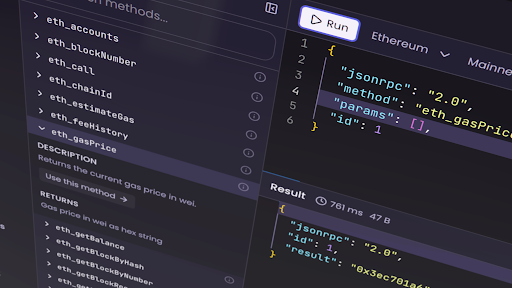
In December 2025, we announced that Ethereum data is coming to Hgraph. We're delivering on that, and we're excited to share that our Ethereum RPC is now live.
Before we get into what that means for Hgraph specifically, it's worth covering what an RPC actually is, because it's one of those foundational pieces that every blockchain app depends on but most people don't think about.
What RPC Actually Means
RPC stands for Remote Procedure Call. It's a way for one program to ask another program to do something, without needing to know the details of how it works. Your app sends a request, the RPC endpoint processes it, and you get a response.
In blockchain, the RPC is how you talk to a node. You're not running the blockchain yourself, you're sending a request to a node that is, and it gives you back the data you asked for. Block data, transaction history, account balances, smart contract state, all of it flows through the RPC.
How It Works
Blockchain RPCs typically use JSON-RPC, a lightweight protocol where you send a JSON object with a method name and parameters, and you get a JSON response back.
A simple example — asking for the current block number:
// Request
{
  "jsonrpc": "2.0",
  "method": "eth_blockNumber",
  "params": [],
  "id": 1
}

// Response
{
  "jsonrpc": "2.0",
  "id": 1,
  "result": "0x134a3c7"
}
That's it. Your app sends a method call, the node processes it, and you get data back. There are methods for reading balances, fetching transaction receipts, calling smart contract functions, estimating gas, sending transactions, all following the same pattern.
Try making JSON-RPC calls in the Hgraph App playground →
Why It Matters
If the RPC is slow, your app is slow. If the RPC goes down, your app goes down. It's that simple.
For developers, the RPC endpoint is the single point of contact between your application and the chain. The reliability, speed, and availability of that endpoint directly affects the user experience. A wallet that takes 10 seconds to load a balance, a dashboard that can't fetch the latest block, a bot that misses a transaction, very often these can be traced back to RPC problems.
Running your own node gives you full control, but it takes real infrastructure to maintain, hardware, uptime, syncing, updates and more. Most teams use an RPC provider like Hgraph instead, which handles the node infrastructure and gives you an endpoint to call.
What to Look For in an RPC Provider
Not all RPC endpoints are the same. A few things that matter:
Uptime and reliability. Public endpoints have rate limits and no uptime guarantees. That's fine for experimenting, but if you're building something that needs to work consistently, you need an endpoint that's built for production traffic.
Speed. How fast the node responds to your request matters, especially for time-sensitive applications like trading bots, alerting systems, or real-time dashboards.
Supported methods. Not every provider supports every JSON-RPC method. If your app needs specific calls, like debug or trace methods, make sure the endpoint supports them.
Multi-chain support. If you're building across multiple chains, managing separate RPC providers for each one adds complexity. A single provider that covers the chains you need simplifies the stack.
Hgraph RPC
We said Ethereum was coming to Hgraph and now we've taken the first step (with much more to come). The Ethereum RPC is now live in the Hgraph App. It supports standard JSON-RPC methods and works with the tooling you're already familiar with.
Using an RPC gives you the ability to read and write to the chain in real-time. Our GraphQL and REST APIs give you indexed, queryable data. Two different things, both necessary.
This indexed Ethereum data is what we're working on next. Be the first to be notified when it's live by signing up to the Hgraph newsletter. If you want to try the Ethereum JSON-RPC, we'd appreciate the feedback. Docs are at docs.hgraph.com.
Build on the same data.
Query live onchain markets across every chain we support through one schema and one key.